
BS 8102:2022, Table 2
The four performance grades for basement waterproofing, in practice.
Selecting the right grade is a decision about the space's intended use. Not the basement's depth, not the contractor's preferred system. The grade governs everything downstream. This is how CLW reads Table 2.
The standard
What is BS 8102?
BS 8102:2022 (often written BS8102) is the British Standard code of practice for protection of below ground structures against water ingress. It is the single most-cited reference document for waterproofing design on UK basements, podium decks and other below-ground structures. It defines the three waterproofing types, Type A barrier, Type B structurally integral, and Type C drained protection, the four Table 2 performance grades explained on this page, the risk assessment the design should rest on, and the competence expected of the person leading it.
It is a code of practice, not statute. But it is written into contracts and warranty requirements, and non-compliance is routinely cited in waterproofing disputes as evidence of a failure to exercise reasonable skill and care. CLW's Ben Hickman contributed to the 2022 revision as a member of the BSI committee; this page and the guides linked from it set out how CLW reads the standard in practice, starting with the decision that governs everything downstream: the performance grade.
Watch the webinar and download the slides
A practical walk-through of the BS 8102 Table 2 environmental grades, with real-world examples - co-presented by Ben Hickman of CLW for the Property Care Association. Enter your details to download the full presentation.
 Watch on YouTube ↗
 Get the presentation
Free PDF of the full slide deck. Your details go straight to CLW - no third parties.
BS 8102 grades in practice: takeaways from the webinar
In the webinar above, waterproofing specialists James Hockey (Trace Basement Systems) and Ben Hickman (CLW) apply the four BS 8102 Table 2 environmental grades to around thirty real basements, car parks and plant rooms. For each space they give the grade they observe and the grade they think is actually required. These are the practical takeaways.
The grade you need depends on use, not just what you can see
A photo of a damp wall does not set the grade. The required performance is driven by how the space will be used, what it will hold and what the client expects - a basic car park and a habitable basement can show identical dampness yet need very different waterproofing. Selecting a grade is really about protecting the investment in the space and making sure everyone has understood, and signed off on, what they are buying.
Grades 1A and 1B: when some water is acceptable
Grade 1A tolerates minor seepage provided it does not affect how the space is used; Grade 1B allows capillary dampness but not running water. The examples make the case for restraint - there is little value in making an earth-retaining wall fully waterproof where rain can simply fall on it. The recurring caution is time: a space sitting at Grade 1A today can drift beyond it as hydrostatic pressure varies, so specifying Grade 1B is often the safer call.
Grades 2 and 3: the same waterproofing, different control of the environment
From a pure waterproofing standpoint, Grade 2 and Grade 3 are the same: neither permits ingress from an external source. The difference is environmental control - managing vapour and condensation with ventilation or dehumidification. Plant rooms with electrical equipment such as switchgear and busbars usually point to Grade 2 as a minimum, depending on the M&E consultants and IP ratings, and condensation beading on a cold, dense surface can fail a grade even when the structural waterproofing is sound.
The difficult cases
Several examples resist a clean answer: ingress near fire-stopping (how much dampness can it tolerate before it must be addressed?), heritage and listed buildings where exposed features and reversible, minimal measures matter, and telling condensation apart from humidity driven by hidden ingress. The presenters are candid that some real conditions fall between the grades - which is precisely why the performance specification matters more than the grade label on its own.
Where Table 2 leaves room for argument
Both are open that Table 2 is imperfect - it was difficult to write and there is genuine difference of opinion among specialists. In practice that is why CLW writes performance specifications that go beyond the grade, for example by defining an acceptable damp-patch area, so the design team, the contractor and the client are held to the same expectation instead of discovering a disagreement on site.
Getting the grade right at design stage - before it becomes a dispute - is exactly the judgement an independent specialist brings. Download the full presentation above, or talk to CLW about your scheme.
This session was co-presented by Ben Hickman of CLW and James Hockey of Trace Basement Systems, who has published his own written explanation of the BS 8102 environmental grades.
Read the full webinar transcript
Auto-generated captions, lightly edited for readability. James Hockey (Trace Basement Systems) and Ben Hickman (CLW) work through the four BS 8102 Table 2 environmental grades and around thirty real-world basement and car-park examples, debating the grade observed versus the grade required.
Good morning everyone and welcome to this month's webinar hosted by the property care association. We have an interesting theme for our discussion this morning. It's BS 8102 environmental grades practical application through real world examples. but before I introduce our presenters this morning can I just give a little bit of housekeeping this webinar is being recorded and will be available to review on the PCA website and YouTube channel a little bit later on. and secondly there is no Q&A at the end of this session but if you want to ask a question make a comment please place that comment in the chat and I'll pick that up and then I can introduce that to our presenters at a at the relevant point. So that's really to our housekeeping for this morning. again our theme for is BS 8102 environmental grade. So it's that lovely table two and it's the practical application through real world examples. Now our presenters this morning are James Hockey and Ben Hickman. James is the managing director of Trace Basement Systems. This is he's a Manchester based waterproofing designer and contractor of MD Base Trace Basement Systems and Trace Remedial Building Services. Now, James has served on the panel that's revised the BS 8102 2022 and has rewritten the basement waterproofing requirements for various structural waterproofing warranty providers. He can deliver complex type A, B, and C combined protection systems across the UK, including landmark below ground projects on the Manchester ship canal in collaboration with tier 1 contractors and architects. Ben is the founder of CLW and is the technical director of Vector Leak Consultants. He's an independent structural waterproofing consultant and past chair of the property care association. He's a chartered building engineer and covers has a masters from the University of Cambridge and served on the committee that authored BS 8102:2022. So, Ben also advises on asset holding developments, tier one contractors on complex basement risks and acts as an expert witness on water ingress disputes. He's the founder of CLW (CSSW.London Limited) and the technical director of Vector Leak Consultants. So, this is an interesting pre presentation around table two. And so what I'd like to do is hand over to our presenters James and Ben for this interesting webinar on table two. Ben,
Leave it to you. Thank you Andrew. I wonder if just before we go further if I could share a little disclaimer. please don't treat this as gospel. This isn't some sort of official PCA policy statement. It's a an open discussion between two experts who I fully expect will have slightly different opinions on some things. but also there's a mutual respect and appreciation and to steal the phrase from the rest of politics. I expect that we will disagree agreeably., I also just wanted to share that this QR code,, a gentleman called Tim is currently doing a bachelor's degree and part of his research is exactly on this topic, BS 8102. It' be lovely if all of you could fill this in. It only takes a couple of minutes. And furthermore, if any of you would be open to a an interview with Tim as part of his research, be lovely if you could message him. if you follow that QR code, you can see his email address in there. James, will you introduce table two?
Sure. thanks Andrew and thanks Ben especially for the disclaimer. so yeah table two obviously that's taken from BS 8102 code of practice for protection of below ground structures against water ingress as an approved code of practice. BS 8102 has an elevated legal status versus other design guides. So it's what we and other designers you know rely on. It's the it's the it's the principal design guide. So,, table two gives us,, definitions of four different environmental grades. We've got grade 1 A, 1 B, two, and three. So, grade 1 A is where you can have a little bit of seepage from, an external source. And as long as the space, can still be used as it was intended, it's, you know, it's fit for purpose, then, you know, that's okay. you might need a little bit of drainage in the floor to kind of accommodate that seepage 1B. you still got some level of water from externally moving to the interior, but rather than that being sort of seepage or liquid water, it's more capillary dampness. Then we go up to grade two. You can no longer have any water ingress from an external source. but you can have some dampness if that is related with vapour. So condensation. you might need to add some environmental controls, maybe some ventilation to manage that manage that vapour. And then we go up to grade three where no again no water penetration is acceptable. But now you definitely need suitable environmental controls. So you're keeping the relative humidity down, preventing condensation and basically you know creating a dry environment. So grade 1 A and 1B allow for some water from an external source. grade two and three are essentially the same from a pure waterproofing perspective and the differences in the level of environmental controls and yeah that's table two. we use it to consider either how dry a space is or how dry a space needs to be. And you know for us sort of selecting environmental grades and you know determining what's needed for a given space like for a given client it's about you know it's like a tool for protecting the investment that is made into the space avoiding loss ensuring that clients understand what they're getting and that they can make informed choices. so that's table two., that's great. Thank you, James. I think just for context,, some people describe BS 8102 as sort of the waterproofing bible and I don't like that., as one of the team of is it eight or 12 of us. We're all just people. there is fallibility and I think we all did our absolute best to make this a useful document but th this table in particular was very difficult there's a lot of kind of difference of opinion there and I guess for context I come very much from a we do a lot of early front-end design and we want to coordinate a design team that are all expecting the same thing and then hold a contract kept a team accountable. so for me it's very much a performance specification piece and that's important to us. I guess the other thing just before I move on to this slide at the end of grade 1 A there's this mention of where this does not impact on the proposed use of the below ground structure. And for the rest of this webinar, I'll probably largely ignore that because it makes things so awkward. James may push back on me on that and that's totally fine. definitions. so these are referenced in under the table there are definitions of damp and seepage and I thought I would share that here. So seepage is defined a slow transmission of water and then there's a I guess this is almost a nested reference to the IC piling specification. I was looking at that this morning and I actually think that the bibliography in BS 8102 is slightly wrong on its date for that which is kind of irrelevant. and then the definition of a damp area is an area which is slightly wet but no seepage., and I'm sure we'll discuss that some more later. I'm just checking my notes., the IC piling specification has some interesting comments, which are kind I think are kind of helpful. A damp patch when touched, a damp patch may leave a film, a slight film of moisture on the hand, but no droplets of water or greater degrees of wetness left on the hand. and we end up in this there's a lot of nuance which I'm sure we will come to. So we have probably about 30 slides which are pictures like this and we intend to take turns in saying what we observe as the waterproofing performance and then what we think is the required waterproofing performance. and I'll write that in my notes. I can't make it go live I'm afraid., but I'm sure there'll be some way of us sharing that at a future date. So, James, what's your what's your take?
Yeah, I think this is an interesting one. I mean, you know, at first glance, I think you can kind of go, well, you know, there's water on the floor., there's drainage and, you know, it's 1A., but me looking at this, I'm like, well, what, you know, what's the actual source of the water there? because it looks like it's been raining. It's open to the elements. I'm looking at that brick work column. It looks it looks super damp at low level. Also above the coping stone. I can't see any indication of ingress through the soffit. It looks like the walls painted white at higher level and black at lower level. I can't see any indication of salts at lower level. the concrete doesn't look great and you know I think I think conceivably a lot of that water could be wind driven rain. It's just pushed beyond the drainage. The drainage runs along the open elevation and then dog legs back where the stairwell is at the at the back there. And it's difficult to sort of say whether this is actually ingress or an issue as a result of water bypassing the you know the below ground structure or even if it is an open deck above it I think it could be it could be quite a lot of quite a lot of rainfall. is it fit for purpose? If it's a, you know, a very basic parking space, then I think, yeah, you know, probably you could say it's, you know, it's sort of reasonably okay. Yeah, you could probably improve the drainage. So I think having said all that then yeah maybe I'd say well it's kind of potentially 1a and that you know that's maybe fit for purpose for that type of space.
Very good. yeah, I think just very briefly I would agree and I think it's one of for me it's one of those rare examples of there are occasions when it is appropriate to design something that is grade one 1A and some CP is tolerable and I like it as an example because what would be the benefit of designing this structure to be more waterproof particularly in on that earth retaining wall. It to me there's just no value in making that a completely waterproof wall if rainfall can fall there. so yeah that's my take as well and I'll make a note of that's grade 1 A observed and grade 1 A is required.
Ben, sorry obviously this is one of your photos. Was there was there was there watering grass that you could see or I don't think so. it was hard to tell what the water was. There was some strange condensation issues in that basement.
I wasn't totally sure where the water was coming from. and I also felt like well it wasn't actually a problem as far as I could tell. Okay. Yeah., did we say we take turns? Am I supposed to go first here? Yeah, this is yours. No, the last one.
Okay., so in one sense, what I can see there is a damp patch., and I was thinking this morning, James, you've probably been in that building., so that looks like a damp patch to me there. There is a darkened patch of concrete or render. And I think the only thing that makes that slightly more complicated is sorry I'm trying to point. Can I point? It's not liking any point just above that red the black line. It looks like maybe that damp patch is extending down and therefore maybe that is water flowing which would be seeped rather than dampness. Oh I can suddenly point. Okay. so to me that's either grade 1 A or grade 1B and because there's local drainage I think grade 1 A is probably sufficient. That's my take. What do you think James?
Yeah I probably said 1 A. I can just see some areas of what looks like calcium carbonate salts above that black band. So maybe at sometimes there is a like a little bit of ingress. if it's if the wall's been rendered then yeah there could just be a little bit of ingress behind and rather than it blowing through the render it's just sort of soaking through it laterally. but either way you've got drainage there haven't you? So,, not great aesthetically, but,, yeah, I'd be like, yeah, you know, 1A,, if it's not affecting the usage, then it's, yeah, it's probably, you know, okay. I mean, it's what it's what was the client told in advance as well, what they're going to get.
Agreed. Brilliant., the next for you., So obviously this looks like a car park. the ingress is fairly minimal not necessarily going to affect the usage. So,, you know, I'd probably say,, I'd probably say 1A., obviously there's no drainage., in table two, it says, you know, you might need drainage. And I think the difficulty with saying, right, yeah, 1A where like there is no drainage is obviously we're just looking at that at one point in time. So the extent of ingress could be influenced by the amount of hydrostatic pressure that comes to bear and that might vary over time. So you know we're looking at this photo at one point in time. It might be a little bit of you know localized ponding flat film of water. but it's difficult to say that it won't it won't get worse you know in time. So,, yeah, I'd probably be advising some, you know, a bit of a bit of risk there.
Yeah. Okay. So, I think you're saying we can see grade 1 A and maybe grade 1 A is acceptable or required. Is that fair? Yeah. I' I'd sort of be like, you know, 1 a, but note that it could get worse in future and it, you know, you might you might then drift beyond
It's not it's not really so fit for purpose. So Okay. I guess my take is similar. I can see some seepage which is probably grade 1 A. I've got a little bit of kind of uncertainty about some of this at the back there. Looks like that maybe there's more water. So, at some point some seepage, it's not some seepage, it's a lot of seepage.
Yeah. And I guess there's nuance there. I guess my take is that tomorrow a car with loads of rain water on it might go and park in that spot and deliver more water than that ingress. Would that be a problem? Probably not. I think what we're looking at is grade 1 A., personally, I would probably specify I want you to achieve grade 1 B., but I think achieving grade 1 A might be acceptable there, too., shall I move on?
Is that is that like a crack propagating from the corner there? Yes. Yes. So it's so it's you know arguably it's a defect. Would you say That one is a defect because we had specified grade 1B. But I think in other circumstances you might say do you know what grade 1 A is okay., and I guess there's nuance there and that's my take., shall I move on?
Sure. Am I supposed to go first on this one? Yeah, it's yours. I think we're looking at a damp patch that is a patch of concrete that is darker., obviously there's a slight crack there., it's to me it's not it doesn't go beyond a damp patch into seepage. so I think what is observed is grade 1B. what is required from what I can see grade 1B it's a struck concrete finish and that's acceptable. What would you say James? Yeah, I think yeah, I think I think what's acceptable is obviously influenced by usage and I think sort of similar to the previous slide with that with that moisture being local to that to that crack, I would be asking the question as to whether what we're seeing is purely as a result of capillary moisture, so it's just wicking through and is there any risk that at some point in time hydrostatic pressure will come to bear and that the outcome of that will then be seepage.
So again probably be I'd probably be sort of advising some you know again what's it being used for? If it was if it was going to be fit out then I' I'd be saying that needs to be obviously dealt with to protect the you know the future investment in the space and avoid loss.
Yeah, of course. If you if you had to say strictly speaking just on the basis of what you can see you can see grade 1B and do you think that is acceptable or do you think what is needed is different to that? Yeah, I agree that I would say it's one 1 B. I think I think beyond that it's you know is that going to is that like a basic car park and it's going to remain as an exposed concrete wall and it's okay now and if it does get worse you've got your strategy for repair because you can see it you can access it you can implement a repair or is it going to be insulated plaster board you know finish
Fixed out you know so yeah I think beyond a point you've got to understand what the usage is going to be and Fair. Good. Next, Ben James got a interesting question here or a comment here from Ian Price. he's asked there looking at the first couple of photographs which we got here. He said, "Should we take the structures durability into account when specifying the waterproofing? I don't want to budge the issue, but I think that's a conversation for another day because that strays into the realm of how do we design it? James might think about that differently, which is fine. But I think if we limit today's conversation to how dry does the structure need to be,
Okay, I would suggest that's a slightly different topic, which I'd love to delve into. What do you think, James? Yeah, I'd agree. I think I think I look at certain designs where people make claims around designing in such a way to enhance durability of structures and then when you actually when you actually dive down into it there are there are limitations within those designs. but yeah I that's not necessarily you know want to get into now.
Thank you. Thank you., Okay. Yeah. So, I'm guessing this is still car parking., maybe we've got a concrete bund detail at low level., we've got discoloration of mortar beds in an area. And then obviously, yeah, look, local to the wall floor junction, it just looks like there's like a bit of, you know,, capillary, yeah, bit of dampness on the on the on the surface there., if it's a car park, then you could be 1 A,, 1B or, you know, depending on,, how dry you want your car park to be, you know, above,, above that. It doesn't look like a substantial issue to me. I guess I'd say observed is one is 1b and you know required yeah 1 A 1 B. I mean it just it just depends.
Yeah, I'd largely agree. It looks like there might be a down pass on that on that kicker. Yeah, if you if you look at the Yeah, if you look at the wall-floor junction there and there's ingress on the wall-floor junction and it's and there's ingress behind then yeah, you could you could maybe reasonably say, well, there's something going on that perhaps should not be going up, you know, maybe there shouldn't be ingress there, but I think you'd have to understand what the original design was. Is this you know is this like a type B behind and then in a leaf of like I don't know you know what I mean?
Yeah. Okay. Channel behind it. Yeah. I think just on the face of it I would say there might be a damp patch in which case it's performing at grade 1B., and what is required? I'd say probably grade 1B just on the base of what I can see.
Yeah. , here's an interesting one. Oh, I'm sorry. I didn't I didn't mean to have that red patch there., am I going first or are you, James? Yeah, this is for you. This one. Okay., so I think if we could ignore the gentleman having a nap because I assume that space is not intended for that purpose., what we're looking at is some vaults. It definitely looks like there is some dampness and some damage to the paintwork at least. I wonder within this red circle is there some ingress maybe. If there's ingress then it's grade 1 A. otherwise it looks like there's some dampness and that's grade 1B. The required waterproofing performance and context would be helpful here. The required waterproofing performance is probably in my opinion grade 1B. that would depend on what is supposed to be stored in these spaces., but the real reason why we were called in is because water was dripping onto the fire alarm here, setting the whole building's fire alarm off, and that meant that the whole building was having to be evacuated frequently., that's my take. What do you think, James?
Yeah, similar really. It's kind of what's the extent of any ingress? It looked like there was some salts and spoiling obviously where you've where you've circled. So you could say sort of observed 1B. I was looking at the cable trays and going well maybe you know if you've got electrical plant and that's being affected then you know maybe you need grade two as a as a minimum. Right. I'm glad that you start with this one.
Yeah. So, so I'm guessing but is this the same space as the previous slide? Same building. Yeah. Different space. Yeah. So dense cementitious coatings and high vapour levels you'll often see this beading effect on the surface which is condensation. So,, just going by this slide alone, if there's no other,,, issue of ingress, although you obviously got mechanical fixings through the tanking, don't know how they were sealed, but, you know, if you're just looking at the condensation, you could say grade two, might need some ventilation or dehumidification to sort that out.
Good. so yeah in the foreground what you can see is droplets of condensation. I like that James used the word beading. That is a defined word in the IC piling specification., I guess I find this one tricky because I think what you what you can witness there is condensation., but I think that condensation is forming more dampness than a damp patch. So, it's not seepage and it's not damp. I think that fails to meet grade two., and I think for me this is why I think I have some discontent with table two. So,, what notes did I say? What did I say in my notes?, I think I think it fails to meet grade two because the level of water is more than dampness. And I also think it fails to meet grade 1B for the same reason. there's more than dampness. It's also not really grade one A because there's no seepage., so I'm not sure what I quantified it as.
I think the approach that I take is if the source of that condensation is vapour, I'd address the vapour and then and then I'd see what you're left with., Yes, I did a I did a remedial scheme which had a tunnel between a house and a leisure suite and they had ingress through the through the soffit and it was sort of tanked above externally and then they redid it and they went on and on and it just kept it just kept leaking. But once it was stripped out beneath they attempted a remedy by applying a slurry to the underside of the soffit. So you basically had a swimming pool full of warm water and then this corridor with this uninsulated cold slowy tanked soffit and you had that beading but it was like the whole soffit was just covered in beading and so this is like a less extreme example of that. Now that was leaking from above. but you could have something here whereby theoretically you know the waterproofing is okay. It's just you've got a very dense, cold, impermeable surface and you know, obviously vapour present in the air all around us all the time and you just the absence of any environmental controls and then yeah, you've got potentially it could just be resulting in this in isolation.
Yeah. Okay. So, I'm genuinely unsure of what my answer would be. Yeah. So if you were an expert witness on a witness box or something and a barrister or somebody was saying, "What grade has that achieved?" What would your answer be?
I mean, I' I would I'd probably say that it's like I it almost falls down between different grades. I would I probably I probably say it's not compliant. It needs some level of environmental controls to potentially achieve grade two.
Yeah. Okay. I think I'm kind of with you. yeah, I'm honestly not sure what my answer would be. I think it fails to meet any grade of waterproofing performance according to table two. What is required? If I was being controversial, I would say grade 1B. I'll leave that hanging. if I may, just because we got quite a few more slides to go through.,, so I think you're going first on this, James. That right?
I'll break it down for you, but I can comment and go for it. All right. Yeah, I would just I would say that this is this is just non-compliant., obviously looks like there's ingress from that from that discoloration and then there's water. in the fire stopping detail. So if the it looks like it's maybe got a cementitious render on it and the fire stopping is external of the waterproofing is what it looks like to me.
So it's bad, you know, bad design, not compliant. Yeah. So my take is that's probably achieving grade 1A. there's some seepage and it probably needs depending on the fire stopping material it might need grade three I don't I would want to check with the fire stopping designer and ask well how much dampness can it can this accommodate and most of us would be familiar if can I point yeah these stickers are fascinating to me particularly since Grenfell But, you know, I often find myself in a basement and I'm supposed to be looking at the waterproofing and then you see a sticker that says, "If this fire stopping is damaged, call immediately, blah." And on several occasions, I've been in a situation where I've then wanted to call that person, but my client doesn't want me to call the firestoppping company. and I think that the fire stopping is a really interesting component. Well, how what waterproofing performance do we need? And I think the fire stopping actually is a very significant question there. So for me, I can see grade 1 A and I think I need grade three, but it would depend on what the fire stopping can accommodate. shall I move on?
Sure., so for context, I'm not sure if that is escape of water or groundwater. I suspect it's actually escape of water from this plumbing., but my take is I think we can see it's maybe grade 1 A if it's not an escape of water., and I think we need probably grade 1B depending on what's the IP rating on all of this kit. What is the client and occupant expectation? What is this the paint and how much dampness can it accommodate?
What do you think, James? Yeah, I was actually assuming that was ingress on the service penetration and I don't know. I think in an electric in a in a plant room with electrical equipment, I probably veer more towards grade two or you know just based on the 2009 standard or will sometimes you know rather than necessarily completely lining out and isolating a plant room you know coming back to sort of protecting investment and avoiding loss. Sometimes we'll advise, you know, no matter what other waterproofing that you've got in place, it might be prudent just to put some cavity membrane on a wall before you fix your services in place. So, sometimes we'll do localized, you know, just as a sort of a get out of jail card if something starts coming in through a structure. where you've got because I've done a few jobs where you've had like substantial electrical installations on retaining walls that have been wet and then trying to un unpick all of that to just put a sheet membrane on a wall is sort of very difficult. So I think you get into kind of a you know cost versus risk consideration.
Yep. Okay., next. Shall I go or do you want to? Do you want to go? I think I can see grade three because I can't see the I can't see any dampness. I can't see any ingress. And the current performance I therefore think is grade three., what waterproofing performance do I think is needed? I'm going to go with grade 1B because to me that plant equipment looks like it is intended to accommodate some dampness and that would be okay. Yeah. that all looks like water pipes to me, you know, like drainage. I wasn't sure whether that sort of outline on the floor was indicative of water. So I was kind of thinking you know is that escape of water from what's in there or is it you know is it a bit of is it a bit of seepage I mean if it's a dry space then yeah it's kind of
Grade two stroke three and it depending well probably grade probably grade two. Okay., so I think that's interesting because I would say grade 1B and you're saying grade two stroke three. Where's the is that you know where's your dampness is that's what determines
I'm saying there isn't any right now but if we're looking at what's required if I was going to specify a grade So we're in a design team meeting and we're talking about well what grade do we need in this plant space it's interesting that I would I would probably say grade 1 B and it sounds like you would probably say grade two or Three.
Yeah. Sorry. I mean required grade in a space like that basic plant room. Yeah. And You know if you had some drains in the floor I think you could have one a Interesting good there is more to get through. I'll go first. looks like there's no dampness or ingress. So it's achieving grade three right now. What is the required grade?, I would say either grade 1B or grade three depending on what the M&E consultants were saying. I' I'd be hesitant to go for less than grade three selling some of the, you know, busbars and things like that probably aren't good with dampness. But to me it would be a conversation with the M&E consultants.
Yeah. Looks like switch gear, doesn't it? So I'd agree. I'd be like, what you know, how dry does it need to be? Yeah. Okay. Looks perfectly dry. Good. Do you want to go first, James? Sure. So I mean again that looks like a dry space to me. you've got you've got plant possibly got heating plant in there. So,, yeah, it's,, probably grade two or if you've got if you've got heat associated with the with the plant, might even be grade three as is. And then, you know, in respect of what's required, I'd probably say grade two with it having electrical equipment in there.
Interesting. Yeah. So, similarly, I would say, well, it looks dry right now, so it's achieving grade three. I wonder if grade 1B would be sufficient. It looks like all the kit is on plinths and it looks like there would be some expectation that there's probably going to be some water splashing around if there's drain down and things like that. But again, depends on what the M&E guys are saying and how dry they think this the space needs to be.
I wonder if I should skip a few James just Sure. Is that right? Are there any that let's look at that one and then I'll skip a few and then we'll get some of the ones that you provided In that grade two stroke three looking at it and you probably want that to be grade three wouldn't you with the stored items?
Yeah. so I think I'm looking at grade three., I think my suspicion is the architectural specification on this concrete finish is not struck concrete. I imagine it's a it's a tighter visual specification and therefore the dampness on that concrete wouldn't be acceptable., yeah, but I like your framing. You know, stored kit likely that the Rolls-Royce owner would want that space to be completely dry.
Yeah., if I skip through a couple,, shout if there are any that you would like to dwell on., Yeah. Yeah. Why don't Should we Should we go through this one?, this is one of yours. Yes. This is habitable space and it was a it was a basement that was tanked externally during construction and then failed and then they tanked it internally and then and then we got a call when it when it failed. So it was stripped out and then there was there was lots of sort of incidences of these defects internally
Throughout the space and but some of them some of them like this were just absolutely tiny. So really the you know it was designed to achieve grade three it wasn't I wouldn't even you know I wouldn't even say it complied with 1A and it required grade three but I think it's a it's an interesting example because you know a pimpric defect like this can have significant impact on
You know the type of property that it that it that it was. Yeah. Yeah. It's interesting that context makes so much difference. to me cold just looking at the pen in the picture, I'm like, well, looks like there's some seepage. So that's grade 1 A. What is the required waterproofing performance? I don't know. Maybe some seepage is fine. but obviously not. If it's habitable space then some seepage would not be acceptable and obviously needs grade three. I like this one. so obviously in this image there's a pizzazza fungus. and James you can correct me. I haven't actually looked it up, but my recollection from my dampened timber training deser fungus is it can only really thrive in wet conditions rather than damp conditions. It's something that likes wet. so because of the fungus, I'm going to say that's wet. So that's probably grade 1A. in its current performance, there's clearly carpet underlay to the to the bottom of the image. So it needed to be grade three.
Yeah. Yeah, spot on. Good., yeah, tell me about this one., so my take when I first look at it is I think it might fail to meet grade 1 A because it looks like there's water running down here. So, it's more than just some ingress.
It's either grade 1 A or it's not even that. Obviously looks like it needs grade three. what's the context there? Yeah, it's a wheelchair lift to a retrofit basement with a with a deck above it and that really convoluted weather line above and so water getting in at high level and then draining down and then affecting the basement. We did actually find ingress through the concrete structure directly into the basement as well, but the vast majority of it was kind of top down., so yeah, I just describe that as non-compliant, you know.
Sure. Okay. Oh, I'm sorry. I thought I'd remove my notes from here, but I'll go first. And obviously I don't know context, but I look at that and it looks like the mould growth to me would suggest condensation rather than ingress. And so I'm going to be slightly controversial and say that's achieving grade two.
So And it needed grade three. Yeah. I think I think as you say it's understanding the you know the context and this was this is an apartment building with deck waterproofing issues and yeah so the source of the water creating enough humidity for mould spores to germinate on the on the plaster was actually water ingress.
Yeah. So again, I'd kind of be saying, well, it's just it's it should have been, you know, the required performance is grade three and yeah, it's just not compliant. Interesting. I don't know the context of this, but I assume it's a basement wall. there's clearly some efflorescence there.
It's an apartment in a million. Okay. So I would say there's some dampness and I say that because of the efflorescence and I think it needs grade three because the timber is embedded into the structure so it's going to decay if it's not bone dry. Bone dry it's a useless term sorry. Yeah. it's a good point about the timber. I think you know it's a heritage structure and you know some would argue for preservation of exposed features and I think yeah it's probably would be difficult to completely protect that timber in a you know using methods that would be considered to be reversible. I just thought this was a sort of an interesting one because you know technically it need grade three, but you could have a discussion with the client. Okay, you want to leave some brick work on show. You basically you're probably going to get some capillary dampness, some efflorescence, you can have some level of maintenance. I'd also say this the external brown level is comparable with the top of the render that you can see at a low level. It's not
It's not completely retaining. Interesting. Yeah. Yeah. Okay. We've got a couple more, but Andrew, feel free to interject if we want to do more Q&A. Is it the last? I think we got two or three more after this. but we can skip some of those. I Let's do this one and one more and then over to you. Is that okay, Andrew?
Yeah, that's it. Carry on. Yep. , so I think we're looking at some grade 1B because there's some dampness and we need grade three. Yeah. Serious tanking and the same apartment. And I think while you can have maybe a bit of a efflorescence on some brick work and you can clean it off, if you've got a type A system, you paint it and it just, you know, breaks down a bit over time and you get cacapillary moisture moving through and salts and then it's blowing the paint off. I think that's not acceptable and yeah, it should be a defect to be addressed.
Okay. And last one. I'm guessing that what we've got is a little bit of seepage. so I'm saying that we've got grade 1 A. what performance do we need? Depends. I don't know what the space is going to be used for. I do have some nervousness about these fixings and how dry do they need to be in terms of you know what's their IP rating. Maybe grade 1A is okay. I don't know. Depends on the context. Yeah. So this is a listed building and I think the floor is mostly affected just by capillary dampness. There are some areas where there is seepage through the through the retaining walls and yeah I think yeah you could maybe say that's like 1A the required grade is on something like this is greatly influenced by you know client preferences in respect of maintaining exposed features and also seeking to facilitate usage of the space and the you know the fit out. So something like this we would be looking at trying to design like minimal measures to try and achieve what they need to achieve. Maybe leaning on the environmental controls design to a degree building in scope for future flexibility upgrade of measures if you don't get what you need to achieve at the at the outset. and sort of trying to design in a rational way. but ultimately you know you could like we'd probably be saying you know to a client you know without comprehensive linings then you're either going to get you know grade 1 A or 1B because we don't you can't categorically say that you might not get seepage through a wall at
Say higher level at a later stage but hopefully you know you've designed in sort of flexibility around that. So, I think listed buildings are really interesting. I think I think within our industry, I'm seeing now and I don't want to go off on too much of a tangent. but certainly maybe you've got companies that are not strictly 100% waterproofing companies. Maybe they put somebody through CSSW and then they go into a historic building and it's like it's going to be habitable usage. I need to render it. I need to put two systems in. I need to render it and then I need to put cav drainage over the top. And it's a bit too cookie cutter. It's not it's not nuanced enough. I think there's a little bit of that creeping in now.
Very good. Well, thank you all., Andrew, any questions that you want to put to us? There is just one and which has been raised and it's and it's one that you've probably heard before or what have you but you know you know Frank was saying Frank Mcinley and saying that you know listening to discussion there is the subjective interpretations of the conditions which will be used for potential objective recommendations as to how to remediate these scenarios. So what he's asking is would a tighter definition on table two or even within the definitions themselves help close this dichotomy?
Do you want I think I think the way that we've structured this webinar is I've put a handful of photos in. Ben's put most of the photos in. And the idea was to was to kind of almost make you have to have like an opinion on the basis of limited information. I think if you if you're actually going through a process of assessing the site and assessing the structure and ex understanding what the existing details are and doing your study and collecting all that information, I think you become, you know, better informed and then you can you can you can be more accurately objective in the in the advice that you that you give. So I think with anything there's always room for improvement and that includes table two but I think in practice it would it probably be a little bit less subjective.
Yeah I' I'd agree with that because you know we've been looking just at some of the just photographs and looking at those images and what but there are other factors which need to be taken into consideration as to you know you know the grade performance of what we're looking for at the end of the day. So you know but this is but this but this has been an excellent you know webinar around table two and how we can view things. So, it's been a been a great webinar. So, thank you. Thank you. Thank you. Thank you, James.
Andrew, can I just give my quick response on that question? Sure. Yeah. Far away. Yeah. And I guess really valid question and that's that sentiment is what's prompted us trying to do this webinar. And I think that the reality is there are a range of opinions., and I think I'm disappointed with what BS 8102:2022 says. I think we all gave it our best shot, but it doesn't have the clarity I would like it to have., I think there are some confusing bits in there. I think I think the introduction of stuff around condensation actually conflates waterproofing with other things. I can understand why we would do it. But I find when we write a performance specification, I might we might write grade 1B, but then we feel like we have to go further than that and explain a maximum damp patch of four square metres is permissible. And so we end up having to try and tighten it up because what we don't want is we the waterproofing designer and the rest of the interdisciplinary design team and the client, we all think this and then you buy it and the contractor does something and they say, "Well, that's great, too. That's fine." And we all need clarity. And I think I would love it to get a bit tighter., but we're dealing with the real world and this sort of the best practice guidance is it's just the attempt of some people to come up with a consensus view. It's imperfect., but yeah, I really get the point.
Brilliant. Thank you. Well, thank you for attending this webinar. It's been very interesting the discussion and we're now bringing to a close the time has beaten us and so I've got some of the comments here which I'll pass on to the presenters and whatever but this will as I said we've this has actually been recorded and we will upload this to our website you know for further review. So thank you all once again for your attendance and we appreciate it very much indeed and we look forward to the next webinar. So I will now close the presentation. Lovely.
Thank you gentlemen. Andrew sorry just before you close do you mind if we just flash up that QR code for the Yeah. Yeah. Sorry, I'm trying to Flip through lots of slides, but it would be lovely if you could scan that QR code and assist him with some research., thank you for hosting, Andrew. Thank you, James. Appreciate you.
Thank you all. Yeah. Thank you. Bye. Bye. Bye. Bye. Bye.
The four grades
Selected by intended use of the space. Never by basement depth.
Performance Grade
G1A
Car parks, plant rooms, storage where seepage is tolerable
Some seepage tolerated
Read in depth
Performance Grade
G1B
Storage with ventilation; non-critical plant
No water penetration; damp tolerated
Read in depth
Performance Grade
G2
Workshops, retail backs of house, secondary commercial
No water penetration; some damp
Read in depth
Performance Grade
G3
Habitable accommodation, offices, retail, leisure, food, archives
Dry environment, controlled humidity
Read in depth
BS 8102:2022 Clause 6 places the grade selection with the waterproofing design specialist. Not the contractor. The grade governs the design strategy, not the cost ceiling.
The 2022 edition
Key changes since BS 8102:2009.
The 2022 edition is materially different from the 2009 version most contractors and many designers still reference from memory. The biggest shifts are around competence, combined protection, and the design specialist's role.
Read the full summary →Agreeing the grade
Who agrees the grade, and when.
The grade should be agreed at RIBA Stage 2, Concept Design, in writing, by the waterproofing designer in consultation with the client, architect and wider design team. It should not be left to the specialist waterproofing contractor at tender stage, and it should not be inferred from the architect's room data sheets after the structural design has been substantially developed.
The grade decision involves three inputs that the design team alone is positioned to provide: the intended use of each below-ground space, the finishes specification, and the ingress protection (IP) rating of mechanical and electrical equipment. M&E coordination at Stage 2 is essential, particularly where plant, electrical equipment, finishes or humidity-sensitive services are proposed below ground.
A grade is a performance requirement. It is not a waterproofing system specification. Table 2 says what the finished space must achieve. It does not say which waterproofing system, Type A barrier, Type B structurally integral protection, or Type C drained protection, should be used to achieve it. That is a separate design decision, governed by the risk assessment. This distinction is the most consistently misunderstood point we encounter in design review.
In CLW's process, the Stage 2 Design Philosophy Document records the agreed grade per zone, the rationale, the responsible party for ratifying it, typically the architect and the client, and the consequences if the grade later requires upgrade.
Type B concrete
How BS 8102 grades relate to Eurocode 2 Part 3 tightness classes.
BS EN 1992-3 (Eurocode 2 Part 3) relates to the concrete design for liquid retaining and containing structures. It is therefore relevant where a Type B structurally integral waterproofing strategy is proposed for a concrete structure, i.e. waterproof concrete.
Tightness classes are the Eurocode 2 Part 3 classification system used to define the acceptable degree of water leakage through reinforced concrete structures, primarily by controlling through-crack widths. Tightness classes and BS 8102 performance grades should not be treated as universally equivalent. However, for Type B reinforced concrete, BS 8102:2022 links Grade 1a to tightness class 0 and Grade 1b to tightness class 1. For Grade 2 and Grade 3 spaces, BS 8102 does not provide a simple one-to-one equivalence with Eurocode tightness classes; instead, it expects additional waterproofing measures and/or combined protection to achieve the required internal environment.
Through-crack widths are typically limited to a maximum of 0.2 mm for waterproof concrete. The infographic below sets out the link between the BS 8102 grades, the tightness classes, and the through-crack width requirements.
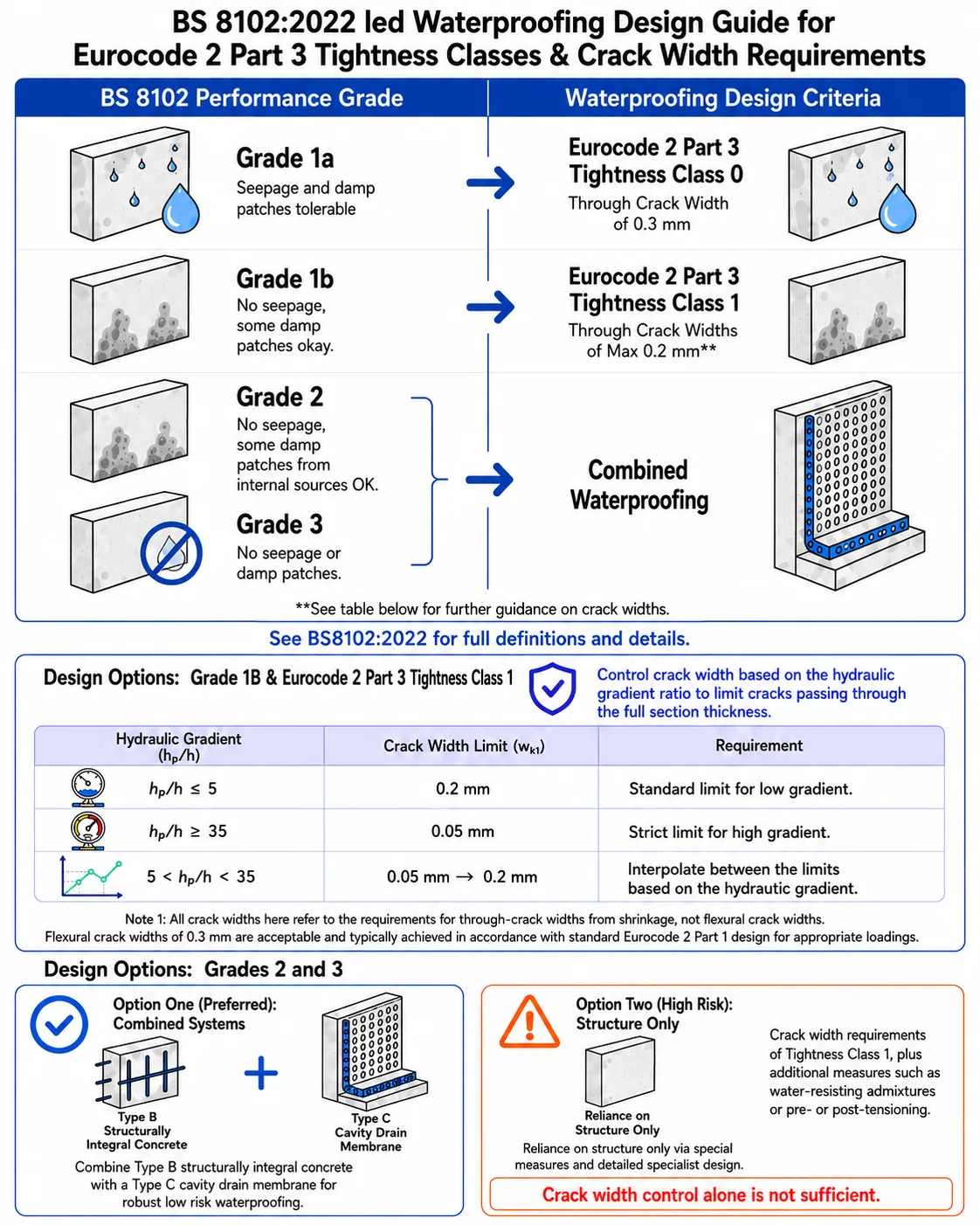
- Note 1: The tightness classes assume that the structure is designed in line with Eurocode 2 Part 1, so that maximum flexural crack widths are 0.3 mm. The crack widths above refer to through-crack widths from shrinkage, not flexural crack widths.
- Note 2: Where combined systems are used and this incorporates a cavity drain system, the risk is reduced and through-crack limits can be relaxed to 0.3 mm (i.e. tightness class 0 requirements).
- Note 3: Where steel sheet pile walls are the proposed Type B waterproofing, additional guidance can be found in SCI guide P452, Steel Sheet Pile Basements. The guidance in Eurocode 2 Part 3 does not apply, unless a concrete liner wall is used.
FAQ
What people ask us first.
What is BS 8102? read
BS 8102:2022 (sometimes written BS8102) is the British Standard code of practice for protection of below ground structures against water ingress. It is the single most-cited reference document for waterproofing design on UK basements and below-ground structures, covering the three waterproofing types (A, B and C), the four Table 2 performance grades, risk assessment, and the competence expected of the waterproofing designer.
What is the difference between BS 8102:2009 and BS 8102:2022? read
The 2022 edition splits the old Grade 1 into Grades 1a and 1b, makes designer competence an explicit requirement, gives the risk assessment teeth (water pressure considered to the full retained height, not the current water table), expects a documented design philosophy, strengthens guidance on combined protection and buried decks, and extends responsibility through construction into maintenance. See the full 2009 vs 2022 comparison linked below.
How many performance grades does BS 8102 define? read
Four, G1A, G1B, G2, and G3. Set out in Table 2 of the 2022 edition. The grade is selected by intended use of the space, not by the depth of the basement.
Who is responsible for selecting the grade? read
BS 8102 is clear that the waterproofing design specialist is responsible for the recommendation, in consultation with the client and the rest of the design team. A grade selected by a contractor with commercial interest in the system being installed is a common failure pattern.
What changed in the 2022 edition? read
Significant changes to Type A, B, and C definitions; a stronger emphasis on competence and the role of the waterproofing design specialist; explicit guidance on combined protection and how it should and should not be relied upon. See the key-changes summary linked below.
Is BS 8102:2022 retrospective? read
Not automatically. BS 8102:2022 applies to new designs and may also be adopted by agreement on existing or ongoing projects. For existing structures, it is often used as current best-practice guidance when assessing risk, performance and remedial options.
Can a single basement contain multiple grades? read
Yes, and most do. The design must show the grade per zone and the detailing at the interface between zones. The higher grade will usually govern the interface unless a project-specific waterproofing detail demonstrates otherwise.
What happens if the grade is not specified at all? read
There is no reliable default. If the grade is not stated, different parties may make different assumptions about the level of dryness required. This can result in a waterproofing design that does not match the intended use of the space. A concrete structure may be designed to resist water ingress, but that does not automatically define the required BS 8102:2022 performance grade. The grade should be agreed early and clearly recorded in the waterproofing design strategy, drawings, specifications, and construction information.
Go deeper: the BS 8102:2022 waterproofing guide sweeps the most-missed clauses in one read, what grade of waterproofing do I need? answers the selection question space by space, and what BS 8102 requires reads the code for the commercial development context.
Also in this series: BS 8102:2022 vs 2009, the key changes, the risk assessment the standard expects, maintainable drainage under BS 8102, does BS 8102 require an independent specialist?, and where to obtain the standard itself.
Need help selecting a grade on a live scheme?
CLW writes the grade recommendation as part of the design philosophy at RIBA Stage 2–3. Defensible, documented, and traceable through to the performance specification.